A water delivery business can become difficult to manage even when nothing obvious goes wrong. The workload often builds gradually until everyday admin starts taking up more time than it should.
One customer changes next week’s order. A driver comes back with fewer empties than expected. Someone in the office is trying to work out which cooler belongs to which account. Then another regular customer rings to pause a standing delivery.
None of these issues creates much work on its own. Across a few hundred customers, though, your team can spend hours updating orders and checking records.
That’s where water management software can help. That is where water delivery management software can help. In this guide, we look at 10 capabilities that can make ordering and delivery easier for bottled-water suppliers in 2026.
Quick Overview
The main capabilities of water management software are:
- Centralised customer ordering
- Recurring delivery management
- Bottle, container and cooler tracking
- Inventory management
- Driver and route management
- Automated invoicing and payments
- Accounting integration
- Traceability and delivery records
- Reporting and business visibility
- Security, reliability and ease of use
What Is Water Management Software?
Water management software is a tool that lets bottled water and scheduled delivery businesses run day-to-day operations from one place. You can track all orders, deliveries, and customers on one system instead of having them scattered across spreadsheets and notebooks.
Let’s look at a typical workflow of a bottled water business.
A customer places the order on Monday, the driver changes the amount at the door on Wednesday, and accounts need the final number for billing on Friday. If each team keeps a separate record, someone eventually has to work out which one has the latest order and delivery details.
With a connected system, everyone works from the same information as the order moves through the business.
10 Capabilities of Water Management Software in 2026
A long feature list of water management software can look impressive without telling you much about what the software will actually do for your team.
How can it make a normal delivery day easier? With that objective in mind, here are the top features of software that are worth considering for your business:
- Centralised Customer Ordering
Think about where your orders come from. Some customers probably call while others might send an email. A salesperson may enter an order after visiting an account. That mix is fine. What causes trouble is having to check three different places before you know what’s actually due for delivery.
Centralised ordering brings those requests into one working view. Your staff can see what has come in and prepare deliveries without switching between notes or separate spreadsheets.
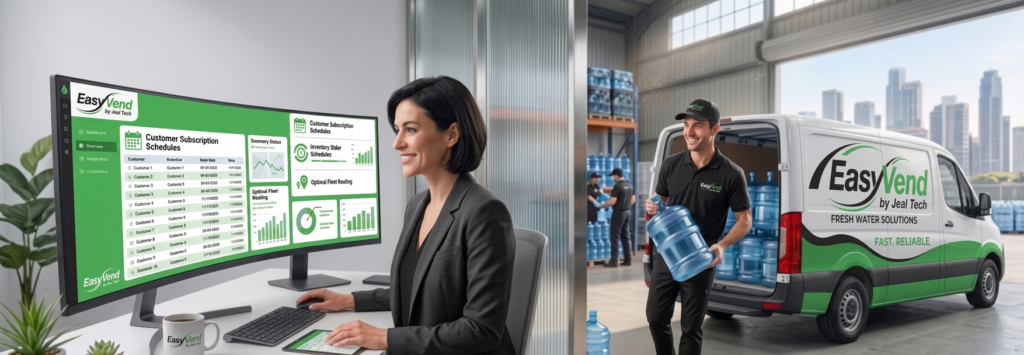
Self-service ordering can take some pressure off too. If a regular customer already knows what they need, they can submit the order on an online portal without waiting for someone in the office to take the call.
If you want to see how these features come together in practice, you can learn more about managing water delivery orders in one system.
- Recurring Delivery Management
When you have a lot of standing orders, removing the repeated entry makes a noticeable difference.
If an office gets eight bottles every Thursday, there’s no reason to rebuild that order from scratch each week. Water system management software can keep the usual order on its regular schedule.
Staff only step in when there are changes in their order. Maybe the customer closes for a public holiday, or they need twelve bottles this week instead of eight. The staff can make those small changes and leave the regular schedule as it is.
Your routine orders can keep moving without wasting time on the same admin every week.
- Bottle, Container and Cooler Tracking
You may know exactly how many full bottles are sitting in the warehouse, but that doesn’t tell you how many empties are still out with customers. Coolers are even easier to lose sight of because they can stay at the same site for months.
A useful water management platform can keep a record of things such as:
- Bottles sent out
- Empties collected
- Containers still outstanding
- Cooler locations
- Deposits or rental charges
Say six bottles go out on Tuesday and only four empties come back. You don’t want somebody in the office trying to reconstruct that balance later from a driver’s notes. With container tracking in place, the customer’s account can show that two bottles are still outstanding.
- Inventory Management
In a delivery business, inventory moves around all day. Some stock is in the warehouse while some is already on a vehicle. Empty containers may still be sitting at customer sites.
So the figure in a stock spreadsheet can quickly become outdated.
A connected water management solution gives the office a more useful view of what’s actually available.
Picture the team loading tomorrow’s route and finding out a popular bottle size is almost gone. That’s the wrong time to discover it. If the shortage is visible earlier, the office can adjust orders or plan around it before the truck is packed. This is why real-time stock visibility is such an important feature.
- Driver and Route Management
Routes rarely stay exactly the same as they looked in the morning. A customer may cancel an order, or another may want an extra delivery added. At one stop, the driver can also find that the customer only needs half the original quantity. These changes aren’t unusual. Losing track of them is the real problem.
If water distribution management software has modern delivery tools, it can record those changes against the right customer order. Your team can see the latest details without checking text messages or handwritten notes.
For regular rounds, the system can also show the day’s scheduled stops and the delivery details for each customer.
Beyond that, a smaller business may be perfectly fine with basic route organisation. Once there are several vehicles and a much denser delivery area, you may need software with dedicated route optimisation tools.
- Automated Invoicing and Payments
There’s no good reason to type the same delivery twice. If the order is already in the system and the driver has recorded what actually went out, that information should carry into billing. So when you compare water management systems, look for an automated invoicing feature that can work from the final delivery details.
Payment tools can take another job off the list. Depending on the system, customers may be able to pay by card or use direct debit instead of waiting for manual follow-up.
- Accounting Integration
Most water suppliers already have accounting software. They don’t need the delivery system to replace it. They just need the two to work together properly.
If you use Xero or MYOB, look for software that can sync the financial information your team currently enters twice.
If there’s no useful connection between them, somebody has to enter invoice or payment information twice, which wastes a lot of time.
And this is one place where a logo on a website doesn’t tell you enough. Ask what actually syncs. An integration that only sends invoices is very different from one that also handles payment or receipt data.
- Traceability and Delivery Records
Here’s a familiar situation. A customer rings and says four bottles arrived. Your invoice shows six.
Now someone has to work out what happened.
If the software has a digital delivery record, that situation is much easier to handle. The staff can check the quantity recorded at the stop and see whether any returns were noted.
Depending on the system, there may also be a signature or another form of proof of delivery. So, you can avoid arguments over what was actually delivered
- Reporting and Business Visibility
You may know your busiest accounts by heart today. A regular customer might gradually cut their usual order in half without anyone noticing straight away.
Useful reports can make changes in sales, route volume, or overdue payments easier to spot.
You can check if sales are slipping in one area, a route is carrying more volume than before, or if outstanding payments are starting to build up.
Also, you don’t need endless dashboards. A few clear reports can give you enough information to spot changes and act on them.
If you are not sure which numbers are actually worth watching, our guide to order management KPIs covers the key metrics that can help you measure ordering, fulfilment and delivery performance.
- Security and Ease of Use
A system can do everything on paper and still be difficult to use in real life.
Imagine a driver standing outside a customer site trying to update a delivery. If it takes five screens and a lot of guessing, they’ll start looking for a shortcut. That’s why ease of use matters just as much as the feature list.
Security matters too, especially when customer or payment information is stored in the system. When you compare water distribution management software, check whether you can control staff access by role and restrict sensitive information to the people who need it.
How to Choose Water Management Software for Your Delivery Business
When comparing different systems, look at how well each one fits the way your business already works. A few simple checks can tell you a lot:
- Use One Real Order As a Test Case
You can ask the vendor to show how the software would handle an order in real life. - Check Where Manual Work Would Still Remain
Find out if staff would still need to re-enter details or move information between systems. - Match The Software to Your Biggest Problems
If bottle tracking is your main issue, make sure the system handles it properly. If recurring orders take up more time, you need to test that part in detail. - Test Changes, Not Just Perfect Orders
Ask what happens if a customer pauses a delivery, changes the quantity late, or returns fewer bottles than expected. - Look Closely at Accounting Integration
If you use Xero or MYOB, check exactly what information moves between the systems and what still has to be entered manually. - Let the Real Users Try It
Drivers and office staff should both see the system before you decide, because they will notice different problems.
Conclusion
Water delivery businesses rarely wake up one morning with an admin crisis. Problems usually build slowly. One spreadsheet becomes two. Someone starts keeping bottle balances in a separate file. Drivers have their own notes. Before long, your staff has to spend too much time checking which record is right.
The right software should cut through that mess rather than add another layer to it.
If your current setup is getting harder to manage, you can take a look at EasyVend. It is an Australian-built platform for food and beverage suppliers that brings ordering, recurring deliveries, invoicing, and delivery management into one system.
Book a demo to see if EasyVend fits the way your team already works.
Frequently Asked Questions
Is Water Management Software the Same as Water Utility Software?
Usually, no. The name overlaps, but the jobs are quite different. Water delivery software is built around customer orders and scheduled deliveries. Bottle or cooler tracking may also be part of it. Utility software is more likely to deal with things such as network infrastructure or water meters. Treatment operations can fall into that category too.
Can Software for Water Management Track Bottles and Coolers at Customer Sites?
It can, as long as the system includes container or equipment tracking. For a bottled-water supplier, that could mean seeing how many returnable bottles are still sitting with a customer. For a cooler rental business, it may show which site has a particular unit and whether rental charges apply.
What Type of Business Needs Water Distribution Management Software?
Water distribution management software is most useful once regular deliveries become difficult to keep organised through paper records or spreadsheets.
A bottled-water supplier is an obvious example. Spring-water distributors can use the same kind of system, and cooler rental businesses may need it for a slightly different reason: they’re tracking equipment as well as deliveries.